30 July 2026
Buy a Property in Australia
Find out how residents and non-residents can buy a property in Australia and how our property lawyers assist with the purchase in any region. Contact us.

Foreigners can buy a property in Australia. This right is granted to those who are residents of Australia but it must be noted that persons who do not live here and simply want to own property can also purchase it. If you are not a resident and you are interested in purchasing real estate, our Australian law firm remains at your service for legal assistance on any property matter.
| Quick Facts | |
|---|---|
| Types of properties foreigners can purchase | Residential property, commercial property, industrial property, specialized properties, etc. |
Mandatory legal representation (yes/no) | No, but it is highly recommended (in some states, the sale contract can be prepared by a property lawyer). |
Main legal responsibilities of property lawyers | If you want to buy a property in Australia, the services of property lawyers can be necessary when: – preparing sale agreements (in some Australian states, only persons specialized in property law can prepare these documents); – offering legal advice on the property law; – making sure all the legal procedures are completed as required by the law; – observing if the property is sold by respecting the criteria in the sale agreement; – providing assistance on the taxes to be paid, etc. |
| Due diligence (yes/no) | Yes |
| Documents necessary for the property purchase | – the sale contract; – make an offer of interest; – loan application documents (if necessary); – documentation attesting that a building inspection has been completed; – establish the type of ownership; – payment of the deposit (usually, 10%). |
| Main property taxes | – the stamp duty (unless exempted for certain categories of buyers and properties); – the capital gains tax; – land tax; – property tax. |
| Parties involved in the sale/purchase of a property | – the buyer; – the seller; – the conveyancer/property solicitor; – commercial banks (when a mortgage is necessary); – the Australian Taxation Office (for tax payments); – the Land Registry Services (for property transfer matters); – a notary public (only where documents are signed abroad). |
| Fees charged by notaries/lawyers (if applicable) | Notarial fees vary from one state to another and from one service to another. For instance, the certification of property transfers can cost from $180. Lawyers’ fees can range from $2,000 to more than $3,000 depending on the property type, its value and the transaction type (loan/no loan). |
| Law regulating property and property sales in Australia | Foreigners can buy a property in Australia following the rules of the Foreign Acquisitions and Takeovers Act 1975, the Civil Law (Sale of Residential Property) Act 2003 (ACT only) and other regulations available in each state. |
| Conditions to purchase for EU nationals | EU nationals can purchase property following the rules applicable to all foreigners who are not residents in Australia. The process for foreigners starts by obtaining an approval from the Foreign Investment Review Board (FIRB). |
| Conditions to purchase for non-EU nationals | Non-EU nationals must follow the same conditions imposed to EU nationals and other third party foreigners. |
| Documents necessary for the purchase of commercial/industrial property | If you want to buy a property in Australia for commercial purposes, the following are necessary: – the sale contract; – GST documents (as the property is for commercial purposes); – financial approval (where necessary); – company documents of the seller and the buyer; – FIRB approval, when the buyer is a foreign entity; – disclosure documents; the certificate of title; – safety regulations compliance, as per the National Construction Code and the building regulations of the relevant state. |
| Institutions involved in the registration of new ownership | The Land Registry Services |
| The mandatory provisions of a property sale contract | The parties, the conditions of the sale, the object of the contract, deadline to meet the obligations of each party, the selling price, the rights of the parties. |
| Types of property contracts to sign in Australia | Contract of sale for residential property, contract of sale for commercial properties. It must be noted that each Australian state has different requirements for a legally recognized property sale contract. |
What are the conditions for buying property as a foreigner?
In the list below, our lawyers in Australia have gathered the basic information that is necessary to know as foreigner (who is not living in Australia) interested in buying real estate:
- foreign applicants are required to submit an application in which they mention they want to buy a property in Australia, application that is submitted to the Foreign Investment Review Board (FIRB);
- then, the applicant must wait for the review of the application and, if successful, the foreigner can purchase the property;
- however, the property itself must meet certain standards – it must be either a new property or a vacant land suitable for residential property, where the new property owner can build a new dwelling.
What types of property transactions are reviewed by FIRB?
According to law, FIRB must review and provide its consent for property transactions involving foreigners that refer to the following types of real estate:
- residential property;
- commercial property;
- development projects;
- large business acquisitions;
- investments made in agricultural land.
We invite you to watch a short video presenting how to purchase an Australian property:

Are there any limitations in purchasing established dwellings in Australia?
Starting with 1st of April 2025, foreign persons can’t acquire properties that are considered established dwellings in Australia. The regulation is available until 30th of June 2029, but there are exemptions from this rule, which can be detailed by our law firm in Australia (such as it is the case of investors who buy a property in Australia that is an established dwelling, for the purpose of redevelopment).
Are there any fees charged to those who buy property in Australia?
Yes, just like in the case of most states around the world, the sale-purchase procedure of a property implies the payment of certain fees and taxes. When initiating this procedure as a foreigner, you will be required to pay certain fees, charged by the Australian Taxation Office (ATO) and by FIRB.
What types of fees should I expect to pay if I want to purchase a property in Australia?
In the list below, our lawyers in Australia present the main fees that can be associated with property purchase in this country:
- state fees, charged by the institution involved in the purchase formalities;
- legal fees, charged by local lawyers and notaries;
- stamp duty;
- foreign purchaser surcharge;
- land tax, etc.
What are the fees charged by FIRB?
FIRB must provide its approval for the purchase of real estate in the cases where the buyers are foreign entities. If a foreigner is approved, then the purchase can begin and one of the steps is to pay an application fee, which varies based on the value of the property and the type of property purchased, as follows:
- starting with 1st of July 2026, the application fee for the acquisition of the new residential properties or vacant residential land starts at $4,600 (when the value of the property is below $75,000) and can reach to $1,245,500 for real estate valued at more that $40 million;
- the fees for established dwellings start from $13,800 for properties valued at a price below $75,000 and can reach $3,736,500 for properties sold at a price of more than $40 million.
Do I need to pay VAT for a property transaction?
That depends on the type of property purchased. When we refer to residential properties, the VAT is charged only for new residential units (sold for the first time). You can learn more about this tax in this article.
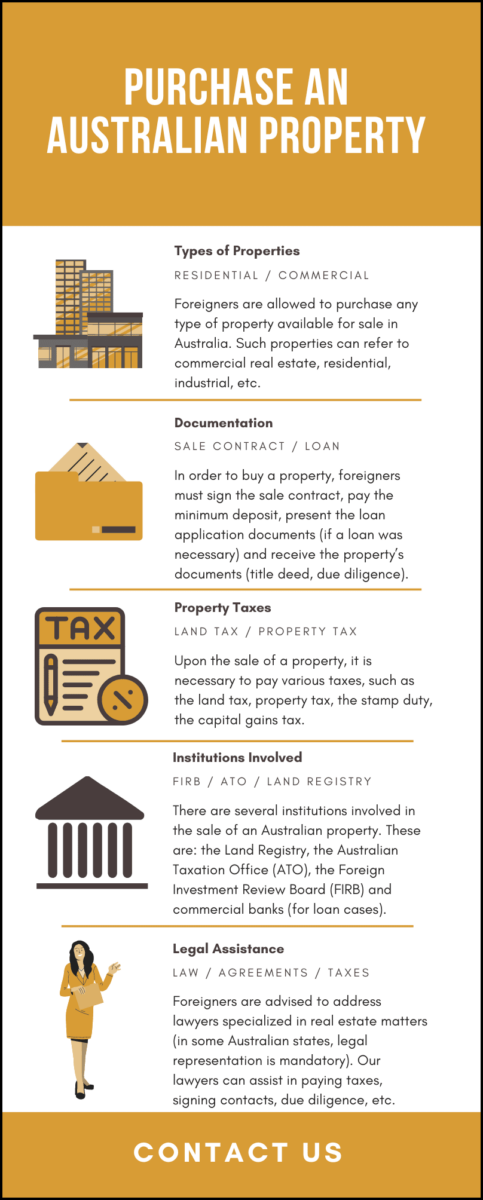
The infographic below contains basic information on how to purchase an Australian property in 2026:
Do I need FIRB’s approval if I live in Australia?
That depends on your residency situation. If you live in Australia as a temporary resident interested in purchasing property, then you will need to obtain the approval of the institution as, according to the applicable legislation, you are considered a foreigner. However, individuals who live in Australia as permanent resident can purchase properties following the same rules available for Australians.
What is a vacancy fee?
The Australian legislation charges what is known as a vacancy fee, a type of tax that is imposed on property owners whose properties in Australia are vacant for at least 183 days a year.
Can you provide other legal services?
Yes, our team can offer a wide range of legal services, for example we can also assist you in immigration matters.
For additional information, our Australian law firm remains at your service.